
Learning Spanish in Colombia: Schools, Tutors, and Immersion Tips
Medellín has quietly become one of the best places in Latin America to learn Spanish. Here's where to study, how much it costs, and the habits that actually build fluency.
IDIOMA DEL ARTÍCULO
Showing original language
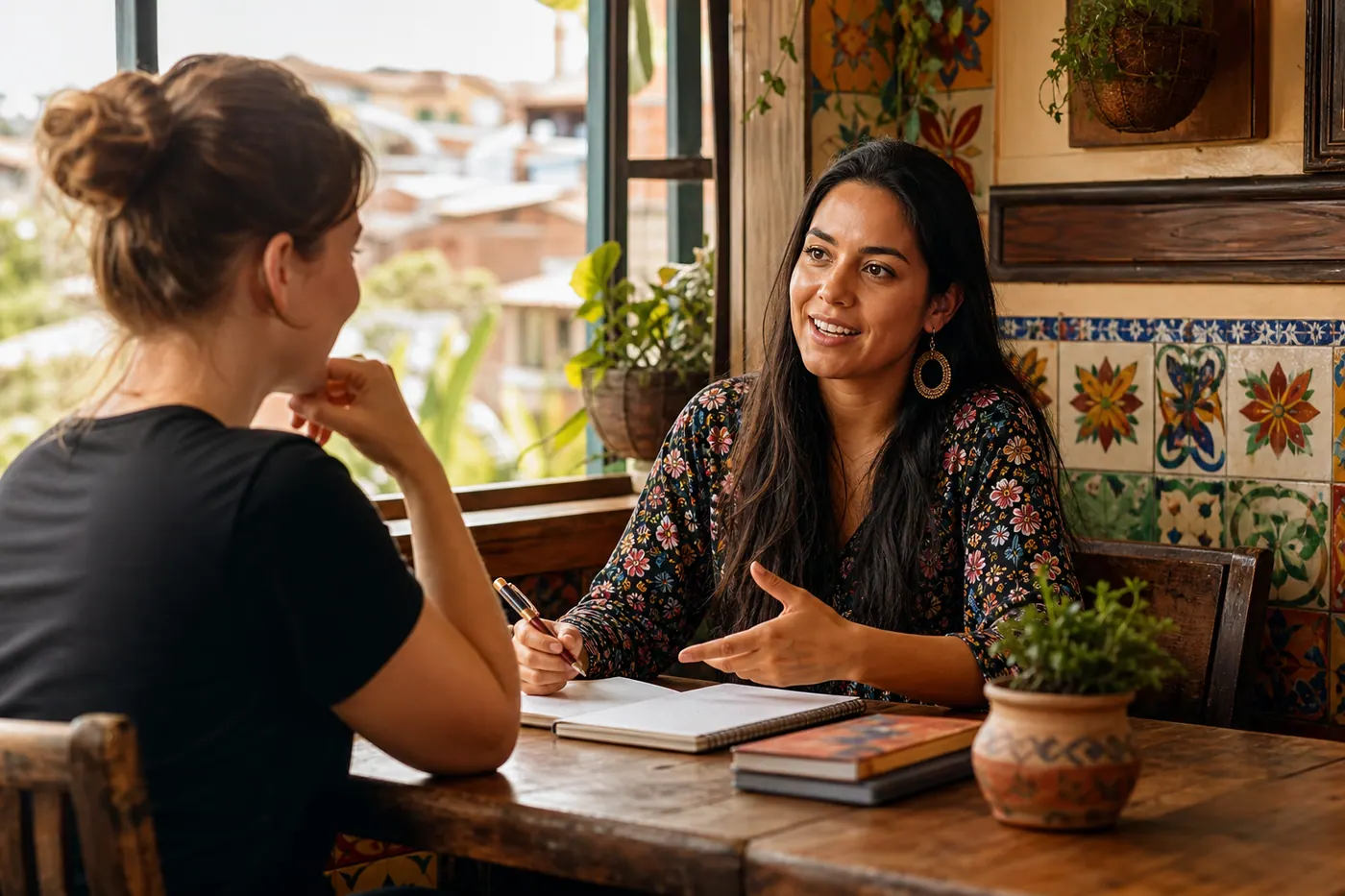
The first thing my Spanish teacher in Medellín told me was that Colombians speak slowly, clearly, and without the slurred swagger of Argentine Spanish or the lisp of Castilian. She said this with total confidence — as someone from Antioquia who genuinely believed her dialect was objectively the easiest to learn. Six months later, I'm inclined to agree.
Colombia has become one of the best destinations in Latin America for learning Spanish, and Medellín is the epicenter. Thousands of foreigners come specifically to study here each year — not as a side activity but as the main reason for the trip. The schools are affordable, locals are patient with beginners, and the surrounding infrastructure (coworking spaces, expat communities, weekly intercambio nights) makes real-world practice unavoidable.
Whether you're planning a few weeks of intensive study or learning Spanish alongside a longer stay, here's what you need to know: where to study, how much it costs, which city actually works better, and the habits that separate people who leave speaking decent Spanish from those who leave speaking exactly what they arrived with.
🗣️ Quick answer: Learning Spanish in Colombia
- Best city: Medellín — neutral accent, affordable, huge expat community
- Group classes: ~COP $400,000–700,000/week (20 hrs); private tutors ~COP $50,000–120,000/hr
- Best free option: intercambio language exchange (Tandem app or weekly meetups)
- Realistic timeline: B1 conversational in 3–4 months of full immersion with daily practice
- Biggest mistake: attending class but only socializing in English
Why Colombia Is One of the Best Places to Learn Spanish
Colombian Spanish — especially in Medellín and Bogotá — is among the cleanest dialects in Latin America. No heavy regional accent, no dropped syllables, no rapid slurring. Bogotá is sometimes cited as having the most "neutral" Spanish in the hemisphere, and while that claim gets debated, the underlying truth holds: it's significantly more accessible for beginners than Mexican, Caribbean, or Río de la Plata Spanish.
Beyond accent, Colombians are remarkably patient with language learners. Ask someone to repeat themselves or slow down and you'll almost never get the mild irritation you might encounter elsewhere. People in Medellín especially — where foreigners are now common — will often correct your grammar unprompted. That's annoying for about thirty seconds and then invaluable.
The cost makes a long stay practical. Intensive programs in Medellín cost a fraction of equivalent programs in Spain, Costa Rica, or Guatemala. And unlike a small language-school town, a full city surrounds you: markets, gyms, football games, restaurants, late-night conversations at a tejo bar — all in Spanish, all available daily.
Your Options for Learning Spanish in Colombia
Language Schools
Formal schools give you the structure most people need to move past beginner plateau. Medellín has the deepest selection.
Nueva Lengua (Medellín and Bogotá) is the most well-known option for foreigners — professional setup, online booking, group and private options. Group classes run around COP $500,000–700,000 per week for roughly 20 hours of instruction. Private lessons are more expensive but far more efficient for most learners.
Toucan Spanish School operates in Medellín and includes cultural activities — cooking classes, day trips, conversation evenings — alongside classroom time. Good if you want immersion that goes beyond grammar drills.
Universidad de Antioquia (Medellín) and Universidad de Los Andes (Bogotá) both run formal Spanish-for-foreigners programs. More rigorous, more academic, and require advance registration. Worth it if you want an accredited certificate or plan to study or work in Colombia long-term.
For something more informal: tutors posting in Facebook expat groups ("Expats in Medellín", "Bogotá Expats") charge around COP $50,000–100,000 per hour ($12–25 USD). Many are qualified teachers doing private work on the side.
Private Tutors and Online Platforms
A private tutor is often the best value — 100% of the instructor's attention, lessons built around your weaknesses, and flexible scheduling. The easiest ways to find one:
- Preply and iTalki — both have Colombian tutors, though pricing is higher than hiring locally ($15–30 USD/hr)
- Facebook expat groups for Medellín or Bogotá — local tutors often post rates around $10–15 USD/hr
- Lingoda — structured online curriculum without needing to find individual tutors; pricier but very consistent
- Word of mouth — ask at your coworking space or hostel; there's always someone whose teacher has a slot open
Language Exchange (Intercambio)
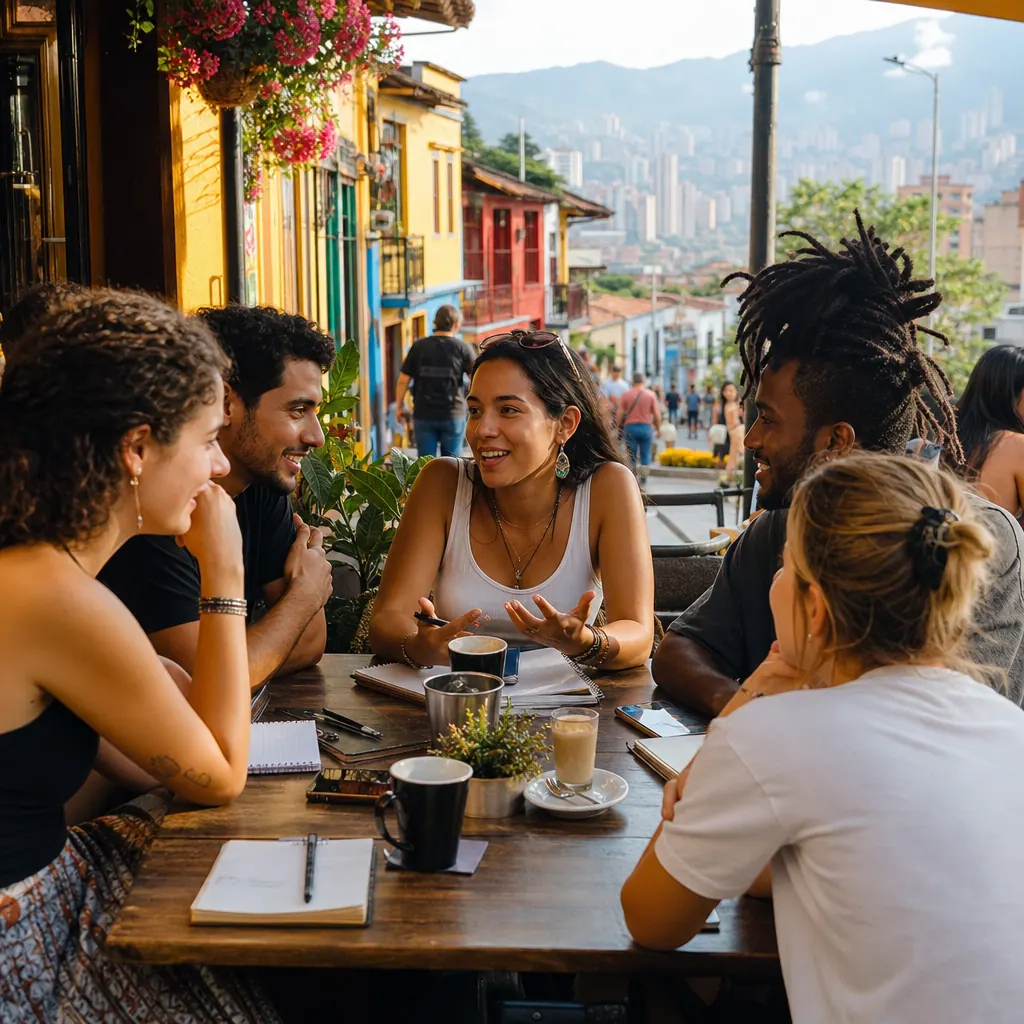
The intercambio model is completely free and one of the most effective practice tools available. You help someone with their English for an hour, they help you with Spanish for an hour. The social pressure of a real human relationship also pushes you harder than a paid class — bailing feels awkward.
Find intercambio partners through Tandem (app — Colombians are well represented), Meetup.com (search "intercambio Medellín" for weekly events), or local Facebook groups. Cafés in El Poblado and Laureles occasionally host language exchange nights — ask around. One practical note: it's easy to let the whole hour slide into English if your partner is eager to practice. Set a timer and enforce the split.
Medellín vs. Bogotá: Which Is Better for Learning Spanish?
Both cities work. The choice depends more on what you want from your stay than on the quality of Spanish instruction.
Medellín has a larger expat community concentrated in certain neighborhoods (El Poblado, Laureles), which is simultaneously its strength and its trap. It's easier to meet people and feel comfortable — but it's also dangerously easy to spend your entire time with other English speakers. The informal, warm culture of Medellín encourages the kind of casual street-level conversation that accelerates language learning: the juice vendor, the taxi driver, the elderly woman at the bakery who will absolutely lecture you about which coffee to buy. If you put yourself in those situations, Medellín is excellent.
Bogotá is harder to navigate socially but academically richer. The city has more formal Spanish programs, a denser concentration of universities and professionals, and a speech pattern that many learners find even cleaner and slower than Medellín. The cold weather also keeps you indoors — which can mean more time with a tutor and less time at rooftop bars. If your primary goal is an accredited program or a structured intensive, Bogotá is the stronger choice.
For most foreigners choosing specifically to learn Spanish: Medellín wins on atmosphere and daily practice opportunities. Bogotá wins on academic infrastructure. Either way, the city matters less than how you structure your time once you're there.
Practical Tips to Actually Make Progress
The difference between people who leave Colombia speaking decent Spanish and people who leave speaking what they arrived with is almost always the same thing: deliberate daily practice outside the classroom. Schools structure your grammar. Immersion builds fluency.
✅ What actually works
- Live like a local at least part of the time. If you're ordering via Rappi, eating at English-friendly restaurants in El Poblado, and socializing at Selina — you're in Colombia, not immersed in it. Shop at the market. Go to a local barbershop. Get lost in a new neighborhood.
- Use Anki for vocabulary. Boring but works. Fifteen minutes every morning with 20 new Colombian vocab words beats passive listening for most people. Vocabulary is the main bottleneck once grammar clicks.
- Watch Colombian TV in Spanish with Spanish subtitles. Betty la Fea and Sin Senos Sí Hay Paraíso are great for learning Colombian expressions and slang. Don't use English subtitles — you'll just read those and tune out the audio.
- Find a weekly commitment in Spanish. A class, an intercambio, a football team, a running club. Something you attend weekly with the same people, where bailing is awkward. Regularity forces you to stay in the language.
- Ask people to correct you, explicitly. Most Colombians won't unless you ask. Say "¿Puedes corregirme cuando cometa errores?" and suddenly you have a free grammar tutor in every conversation.
The only thing I'd add: don't be embarrassed by making mistakes in public. Colombians find it endearing, not cringeworthy, when a foreigner genuinely tries. The humiliation of a bad conjugation fades. The memory of the conversation stays.
What Does It Actually Cost?
Here's a rough breakdown of Spanish learning costs in Colombia (2026 rates):
| Option | Typical Cost |
|---|---|
| Group classes (20 hrs/week) | COP $400,000–700,000 |
| Private tutor (per hour, locally) | COP $50,000–120,000 (~$12–30 USD) |
| Preply / iTalki online tutor | $15–30 USD/hr |
| Intercambio language exchange | Free |
| Anki / Duolingo | Free |
| Room in Laureles or Belén (Medellín) | COP $800,000–1,500,000/month |
Total cost of a Spanish-learning month in Medellín — including accommodation, food, transport, and 20 hours of group classes per week — typically lands between COP $2.5M and COP $4.5M (roughly $600–1,100 USD). A comparable immersion program in Spain or Costa Rica would easily run $2,500–4,000 USD for the same period.
Keep Reading
Frequently Asked Questions
❓ Is Colombia a good place to learn Spanish?
Yes — one of the best in Latin America. Colombians speak clearly and relatively slowly, locals are patient with beginners, and costs are low enough to support an extended stay. Medellín specifically has built an entire infrastructure around Spanish-learning foreigners.
❓ Is Medellín or Bogotá better for learning Spanish?
Medellín for atmosphere and daily immersion; Bogotá for formal academic programs and accredited certificates. For most language learners, Medellín wins — the city is smaller, warmer socially, and easier to navigate — but you have to actively seek out Spanish-speaking situations in a city with a large English-speaking expat scene.
❓ How long does it take to reach conversational Spanish in Colombia?
With daily classes plus real-world practice, most people hit B1 (basic conversational) in 3–4 months. Full immersion — meaning you're not retreating to English all day — can get you there faster. Complete beginners starting from zero realistically need 6+ months to hold a genuine conversation.
❓ Can I learn Spanish in Colombia without taking formal classes?
Yes, though it's slower without structure. Intercambio, Anki, Spanish TV, and deliberately living in Spanish can build real fluency. Most people who skip classes plateau at intermediate because nobody corrects them and they keep using the same vocabulary they already know.
❓ What's the best app for learning Spanish alongside Colombia immersion?
Anki for vocabulary retention — non-negotiable. Tandem for finding language exchange partners in Colombia. Duolingo is fine for building a daily habit but too shallow on grammar to carry you past beginner. For grammar structure, Pimsleur or Babbel as a supplement to actual classes is a better use of your time.
💬 Questions about learning Spanish in Colombia?
Post in the Colombia Move community — other expats and locals can share school recommendations, tutor contacts, and intercambio tips from wherever you're based.
Ask the community →

Comments
Loading comments...
Checking sign-in status...