Colombia Digital Nomad Visa: How to Apply and What to Expect
Colombia's digital nomad visa lets remote workers live legally in the country for up to two years. Here's exactly how to qualify, apply, and what to do after approval.

Idioma del artículo
Listo para traducir
The first time I really understood Colombia's visa rules wasn't from an official document. It was watching a friend frantically Google 'can I work on a tourist visa Colombia' two weeks before his six-month lease was set to start. He'd been remote working from Medellín for three months, loved it, and was only now asking the question he should have asked before booking his first flight.
The answer — legally — is no. Colombia's tourist visa doesn't permit work, including remote work for foreign employers. But the government recognized by 2024 that hundreds of thousands of remote workers were living here in a legal gray area, and created the Visa V - Actividades con Entidades del Exterior: the digital nomad visa. It's a real, two-year visa that lets you live and work remotely from Colombia without the quiet anxiety of being technically undocumented.
This guide covers who qualifies, exactly which documents you need, how the online application actually works, and what to do after you arrive. No fluff — just the process.
What Is the Colombia Digital Nomad Visa?
The official name is Visa V - Actividades con Entidades del Exterior — 'Activities with Foreign Entities.' In expat circles it's universally called the digital nomad visa or just the nomad visa, and the shorthand has stuck even in official conversations. Colombia introduced this category as part of a broader push to attract remote workers who were already living here informally.
What the visa covers: you can live in Colombia for up to two years, working remotely for employers or clients based outside the country. At the end of the two years, you can renew once for a further two years — meaning up to four years total on this visa path. After that, you'd need to switch to a different category.
One important structural limitation: time on the nomad visa does not count toward Colombia's five-year permanent residency track. Residency accumulation requires a Visa M category (employer-sponsored or independent). If long-term residency is your eventual goal, keep this in mind when planning your visa sequence. The nomad visa is excellent for a two-to-four-year stint; it's not a stepping stone to a cédula permanente.
Who Qualifies: Income and Insurance Requirements
The qualification bar is intentionally straightforward. Colombia wants remote workers who can support themselves — the requirements reflect that, not some bureaucratic obstacle course.
Income Threshold
You need to demonstrate monthly income of at least three times the Colombian legal minimum wage. For 2026, the minimum wage is COP 1,423,500/month, so the requirement is approximately COP 4,270,500 — roughly $1,040–$1,080 USD at current exchange rates. For most North American or European remote workers, this is easy to meet; it's set low enough to be inclusive, not exclusive.
Employees show this with three months of recent pay stubs plus a current employment contract. Freelancers and self-employed workers show it through bank statements covering the last three to six months, alongside invoices or client contracts that make the income source clear. The key word is 'foreign' — the income needs to be traceable to clients or employers outside Colombia.
Health Insurance
Your policy needs to cover medical services in Colombia and include a medical repatriation clause. Most nomad-specific insurance products handle this. SafetyWing is widely used by expats in Colombia and their policies explicitly meet the visa requirement — just download the full policy documentation and confirm the Colombia coverage and repatriation language is there. Cancillería reviewers look for those specific terms.
Foreign-Sourced Income Only
This is the restriction that matters most day-to-day. On the digital nomad visa, you cannot earn income from Colombian employers or Colombian clients. No invoicing a Bogotá startup, no picking up a local consulting project, no receiving pesos as employment compensation. If your work is genuinely remote and all your clients are abroad, this isn't an issue. If you're building a Colombian client base, you'd be looking at the Visa M - Independiente instead.
Documents You'll Need
The list is shorter than most people expect. For a Visa V application, you'll typically need:
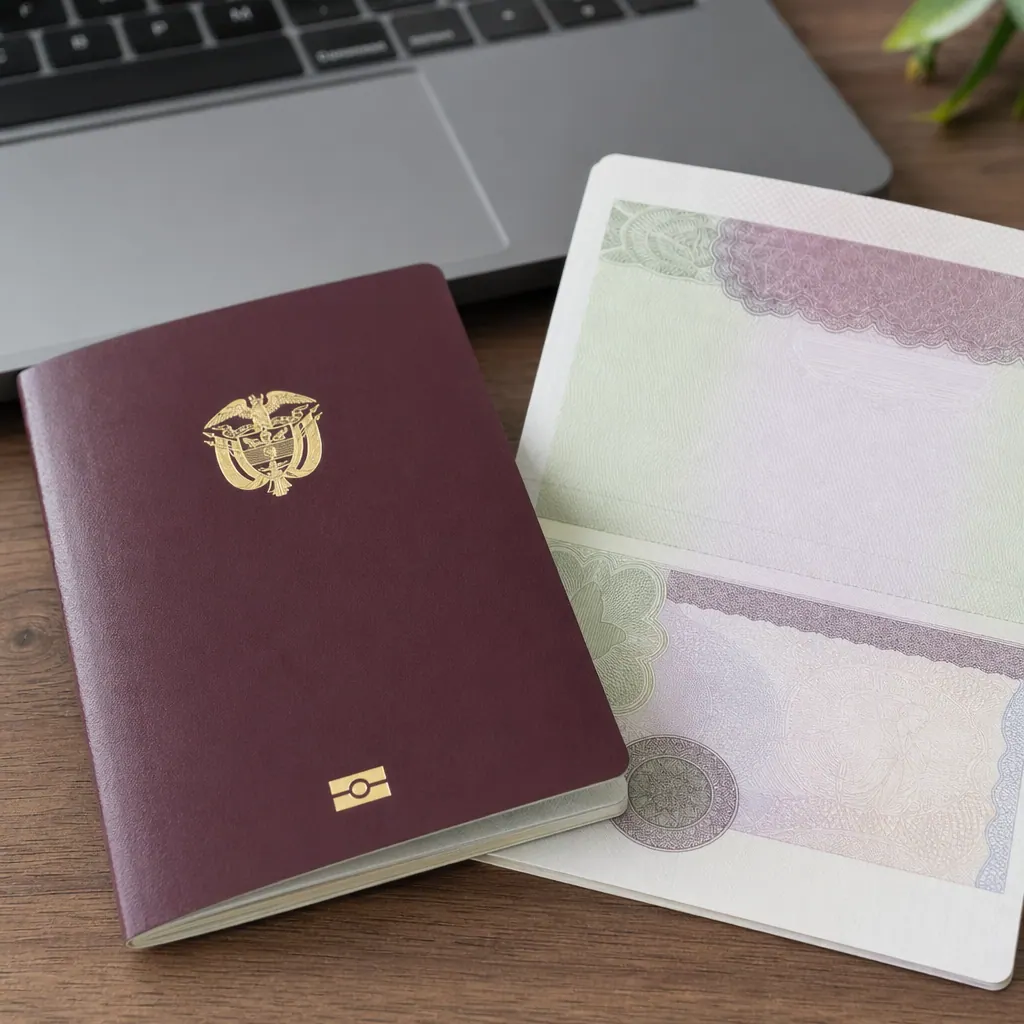
- Valid passport — at least six months of validity beyond your intended stay, with two or more blank pages
- Passport-style photo — 4cm × 3cm, white background, taken within the last 30 days
- Proof of income — employment contract + last three pay stubs (employees), or bank statements + invoices/client contracts (freelancers)
- Bank statements — last three months showing income at or above the threshold
- Health insurance documentation — must explicitly state coverage in Colombia and medical repatriation
- Application fee payment — approximately $52 USD, paid during the online process
Cancillería can request additional documentation at their discretion. The most common extra ask is a criminal background check — ideally apostilled if from a country that's part of the Hague Convention (the US, UK, Australia, and most EU countries qualify). My strong advice: get your background check apostilled before you apply, even if it isn't listed as required upfront. If your application gets queried, having it ready saves two to three weeks. The FBI check plus apostille process in the US takes 6–10 weeks if you do it yourself, less through an expediting service.
Applying Step by Step
Colombia's visa applications are entirely online through the Cancillería portal at visas.cancilleria.gov.co. You can apply from anywhere — including from within Colombia if you're already here on a tourist visa. No embassy visit, no consulate appointment.
Step 1: Create an account on the Cancillería portal. Use an email address you check regularly — all communication about your application comes there.
Step 2: Start a new application and select Visa V → Actividades con Entidades del Exterior. The category is in the dropdown under the Visa V section, not Visa M.
Step 3: Fill in the application form — personal details, passport information, your planned address in Colombia, employment or client information, and income documentation. Take your time; errors here slow things down.
Step 4: Upload your documents. Everything goes in as PDF or high-quality image files. The system has a per-file size limit (usually 2MB), so compress large multi-page bank statements before uploading — an 8MB bank statement PDF will not upload cleanly.
Step 5: Pay the application fee. As of 2026, it's approximately $52 USD, payable by international credit or debit card through the Cancillería platform.
Step 6: Submit and wait. Officially, Cancillería has 30 calendar days to process Visa V applications. In practice, approvals often come within 5–10 business days during non-peak periods. January through March tends to be slower — budget the full 30 days if you're applying then.
Step 7: If approved, you'll receive an electronic visa document by email. Print it. You'll present it when entering Colombia, and it gets stamped in your passport. If you're already in Colombia when approved, take the printed document to Migración Colombia.
After Arrival: Getting Your Cédula de Extranjería
This is the step a surprising number of people skip. Once you're in Colombia with your visa, you have 15 days to register with Migración Colombia and apply for your Cédula de Extranjería — your Colombian foreign ID card. This document is what actually unlocks practical life here.
Without the cédula, you're stuck using your passport for everything. With it, you can open bank accounts, activate Nequi and Daviplata, sign leases without a fiador (guarantor), get a contract phone plan, and access healthcare as a registered resident rather than a tourist. The cédula is not optional — it's the difference between living in Colombia and just visiting.
The appointment system has historically been backed up, especially in Bogotá — sometimes four to eight weeks wait. Book your appointment online at the Migración Colombia portal on day one of arrival, even if the slot is weeks away. Migración generally understands when the backlog pushes past the 15-day window, as long as you have a confirmed appointment. After your appointment, the cédula takes another two to four weeks to process. Carry your passport and printed visa everywhere in the meantime.
What You Can and Can't Do on the Nomad Visa
Being clear on this saves a lot of confusion later:
✅ You can
- Work remotely for foreign employers and clients
- Open Colombian bank accounts (with cédula)
- Rent apartments without a Colombian guarantor
- Drive with your foreign license for up to 6 months
- Access private healthcare as a paying patient
- Travel freely in and out of Colombia
❌ You can't
- Work for Colombian employers or clients
- Invoice Colombian companies for compensation
- Count these years toward permanent residency
- Practice regulated professions without separate authorization
One practical note: if you're regularly working from cafés or coworking spaces, using a VPN is worth it. NordVPN works reliably in Colombia and is useful for public Wi-Fi security as well as accessing geo-restricted streaming content from home.
Renewing Your Visa and Planning Beyond Four Years
The digital nomad visa can be renewed once, giving you up to four years total. Renewal works similarly to the initial application: submit updated income documentation still meeting the threshold, updated health insurance coverage, and the renewal fee. Start the process at least 30 days before your current visa expires — don't wait until the last week.
After four years, your options narrow. You can switch to Visa M - Independiente if you want to stay and work with Colombian clients (and start the residency clock), transition to an employer-sponsored Visa M - Trabajo if a Colombian company wants to hire you, or leave. Some expats deliberately sequence it: a few years on the nomad visa while getting established, then a switch to M - Independiente to begin the five-year residency track.
If Colombia is your long-term plan, map out that sequence before you start. The nomad visa is a great entry point — just don't sleepwalk into year four without a plan.
🇨🇴 Have a Visa Question?
Colombia's visa rules have enough nuance that the right answer depends on your specific situation. Ask the community — expats who've been through the process recently are active and helpful.
Ask the Community →Frequently Asked Questions
❓ How long does the Colombia digital nomad visa take to process?
Officially, Cancillería has 30 calendar days. In practice, approvals often come within 5–10 business days during non-peak periods. January through March tends to be slower. Build in the full 30 days when planning your timeline.
❓ Can I apply for the Colombia digital nomad visa while already in Colombia?
Yes. The application is entirely online and can be submitted from anywhere, including from within Colombia on a tourist visa. Your current immigration status must be valid while the application is pending — don't let your tourist stamp expire before your nomad visa is approved.
❓ Does the digital nomad visa lead to permanent residency?
No. Time on the Visa V (digital nomad) category does not count toward Colombia's five-year permanent residency track. To build toward a Visa R, you need qualifying time on a Visa M — employer-sponsored or independent. Some expats spend their first few years on the nomad visa, then transition to M - Independiente when they're ready to commit long-term.
❓ What health insurance is accepted for the Colombia digital nomad visa?
Your policy needs to explicitly cover medical services in Colombia and include medical repatriation. Most international nomad insurance policies qualify. SafetyWing is widely used by expats here and meets the requirements — just download the full policy documentation rather than the summary card, since Cancillería needs to see the specific coverage terms.
❓ Can a freelancer qualify for the digital nomad visa?
Yes. Freelancers with foreign clients can qualify by showing consistent income above 3x the Colombian minimum wage through bank statements and client contracts or invoices. All income must come from outside Colombia — taking Colombian clients doesn't count toward the threshold and technically disqualifies the visa category for that work.
Ready to Make the Move?
The Colombia digital nomad visa is one of the more accessible legal paths for remote workers globally — the income threshold is low, the process is entirely online, and two years of legal status gives you time to actually build a life here rather than perpetually counting tourist stamp days.
If you're in the process of applying, or you've already done it and have tips from your experience, drop them in the comments below. The quirks that official documentation doesn't cover — which documents actually get requested, how long the queue is at a specific Migración office, how to handle a follow-up request — are worth sharing. Real-world experience from people who've done it recently is worth more than any government page.
Work in Colombia
Find jobs on Colombia Move

Next step
Use this information on Colombia Move
Find work or post a role.
Colombia Move connects jobs, candidates, and services in one bilingual marketplace.
Browse jobsAsk a Colombia-specific question
Get practical answers from people already handling life, paperwork, and moves here.
Ask the communityPost free
Listing on Colombia Move is free, bilingual, and built to be found from search.
Post a jobWork in Colombia
Find work or post a role.
Colombia Move connects jobs, candidates, and services in one bilingual marketplace.
Keep reading
Related guides
vivienda
Cómo Revisar un Contrato de Arriendo en Colombia Antes de Firmar
Lo que debés revisar en tu contrato de arrendamiento antes de firmar: canon, depósito, inventario, cláusulas abusivas y el inventario que casi nadie hace.
visas
Resident Visa Colombia: Paths, Timelines and Common Mistakes
Colombia's permanent residency is achievable — but the rules around absences, qualifying visa categories, and document timing trip people up more than the requirements themselves.
visas
I Got Colombia's Marriage Visa Without an FBI Background Check
I was approved for Colombia's Visa M Cónyuge without submitting an FBI background check. Here is what the official checklist actually said and what worked for us.
healthcare
Travel Insurance for Colombia: What Actually Works (Before You Have EPS)
Tourists and digital nomads can't access Colombia's EPS system. Here's which travel insurance options actually work — and what the fine print usually misses.
Explore by topic
Comentarios
0 comentarios de lectores de Colombia Move
Cargando comentarios...
Inicia sesión con tu cuenta de Colombia Move para comentar.
Iniciar sesión