
Pico y Placa in Colombia: City Guide for Bogotá, Medellín, Cali and More
Pico y placa changes by city and rotates every certain time. Here you have the clear guide: schedules, days, fines and how to avoid the problem.
IDIOMA DEL ARTÍCULO
Showing original language
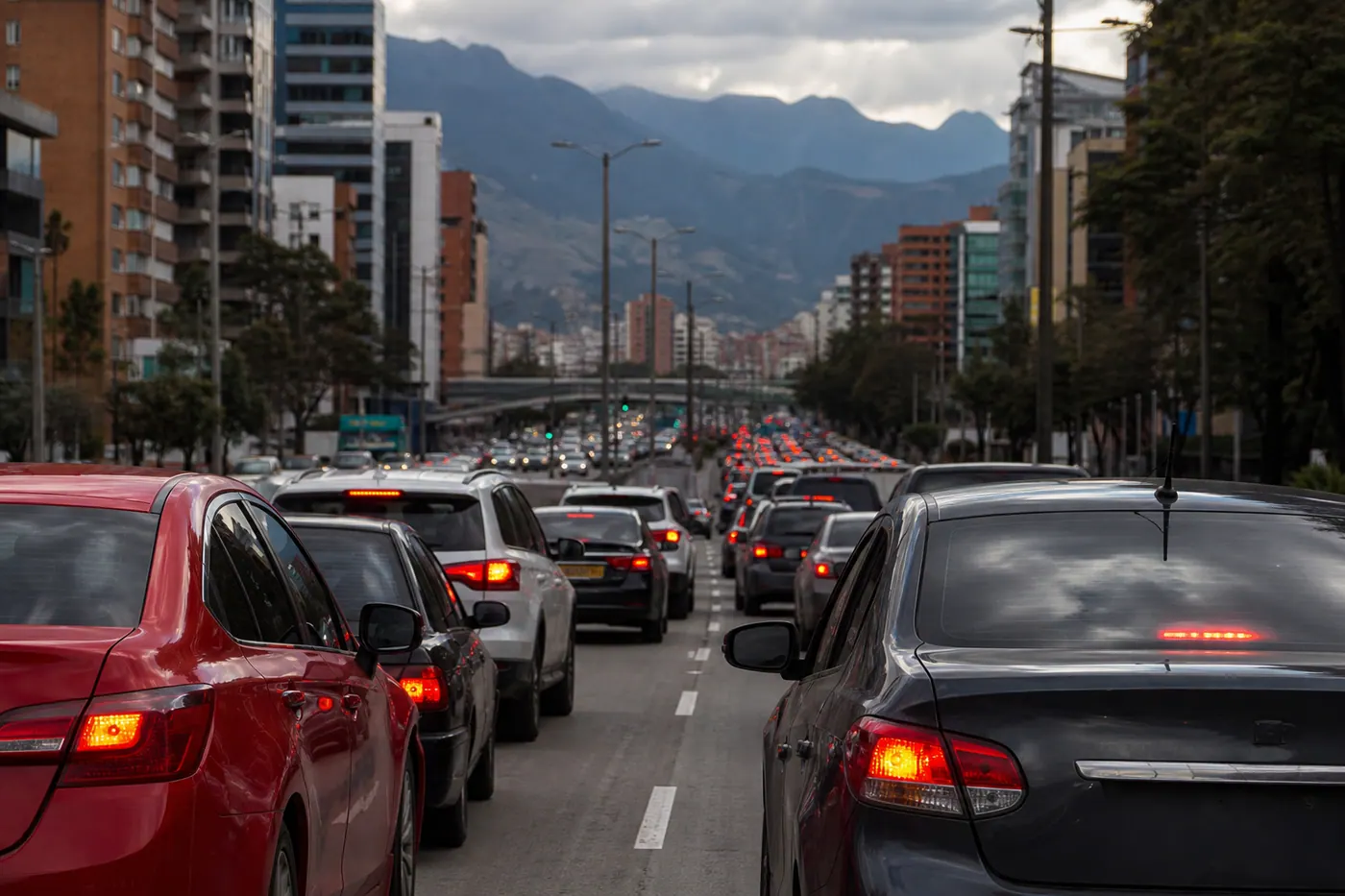
If you drive in Colombia, at some point it will happen to you: you're running late to a meeting, you get in the car, turn on the engine and realize that today you have pico y placa. And the worst part isn't the surprise — it's that each city has different rules, schedules change mid-year, and what you learned in Medellín doesn't apply in Bogotá or Cartagena.
This guide is the version I wish I had the first time I lived with a car in Colombia. It summarizes how pico y placa works in the six main cities — Bogotá, Medellín, Cali, Cartagena, Barranquilla, Bucaramanga and Pereira — the schedules updated to 2026, the fines, the real exceptions (not the ones that appear on social media without a source), and a couple of tricks to keep you from getting stranded on the days your restriction applies. If you want to see real options right now, you can see cars and motorcycles available in Colombia Move — posting is completely free.
Warning: this document focuses on private vehicles. Taxis, motorcycles, cargo transport and dump trucks have different rules in each city — if you drive any of those, consult directly with the local Mobility Department because they change frequently.
How pico y placa works in Colombia
The basic idea is the same throughout the country: on certain days of the week, cars with certain last digits on their license plates cannot circulate during certain hours. The intention is to reduce traffic during rush hour and lower pollution. Each mayor's office decides its own scheme, so there is no "national pico y placa" — Bogotá rotates by even and odd days, Medellín assigns two digits per day of the week, Cartagena has two windows (morning and afternoon) instead of a continuous schedule. If you move or travel with a car, assume that the rules you know don't apply.
Almost all cities share three things: the measure applies Monday to Friday (except Bucaramanga which also restricts Saturdays), it doesn't apply on holidays, and the rotation adjusts every semester or quarter. That means the day your restriction applies today might not be the same in three months. It's worth setting a reminder every time it rotates.
The fine for non-compliance is the same throughout the country: 15 daily legal minimum wages (SMDLV) — for 2026 that's around $711,750 pesos — plus vehicle immobilization, which means the car goes to the impound and you have to pay for towing and parking before you can get it out. In practice a single fine can cost you between $900,000 and $1,200,000 pesos all together.
Bogotá: even/odd from 6 a.m. to 9 p.m.
Bogotá has the strictest schedule and the simplest system to explain — but also the easiest to get confused about if you're coming from another city.
The measure applies Monday to Friday, from 6:00 a.m. to 9:00 p.m., continuously. There are no lunch breaks. The rotation is by calendar day:
- Odd days (1, 3, 5, 7…): plates ending in 1, 2, 3, 4 and 5 can circulate
- Even days (2, 4, 6, 8…): plates ending in 6, 7, 8, 9 and 0 can circulate
That is: if your plate ends in 4, you can't circulate on even days. If it ends in 7, you can't on odd days. It's counterintuitive at first because the days you have restrictions don't always fall on the same day of the week — the same car might have pico y placa on Monday one week and Tuesday the next, depending on how the calendar falls.
Pico y Placa Solidario: the permit that actually exists
Bogotá is the only major city with an official system to pay and circulate on the day your restriction applies. It's called Pico y Placa Solidario and is managed by the District Mobility Department. You buy a permit for a day, a month or a semester, and the charge depends on the car's assessed value, its age and whether it's registered in Bogotá or not.
For 2026 there's an important change that few people know about: the multiplier factor for vehicles registered outside Bogotá went from 1.2 to 1.5. If you have your car registered in another city and use it in Bogotá, the permit costs you 25% more than before. For many returnees or people who moved to Bogotá but left their car registered in their hometown, this changes the math.
The process is 100% online at picoyplacasolidario.movilidadbogota.gov.co, you pay by PSE, and the permit is linked to the plate. Before you buy it, use the rate simulator to see how much it will actually cost you based on your car — a 2015 Renault Logan doesn't pay the same as a new SUV.
Medellín and the Aburrá Valley: two digits per day
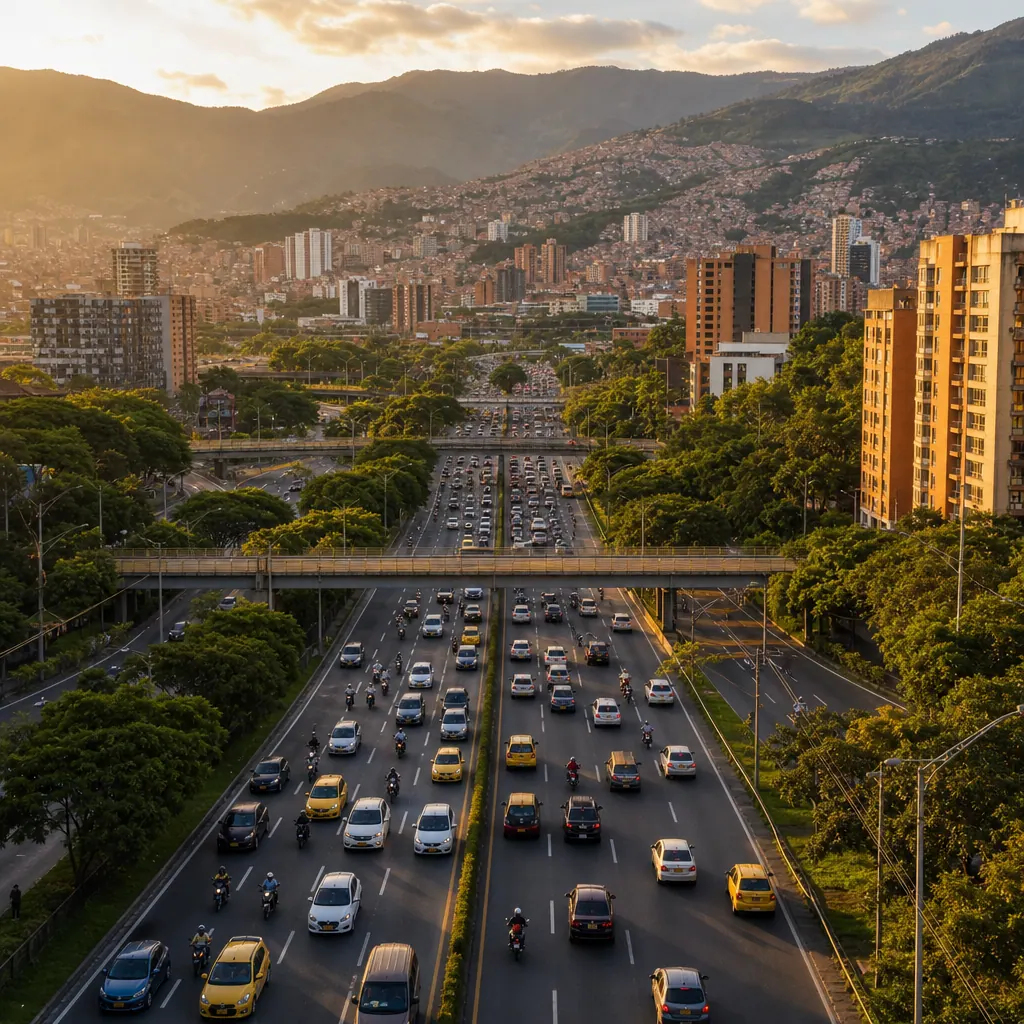
Medellín and the municipalities of the Aburrá Valley (Envigado, Itagüí, Bello, Sabaneta, La Estrella, Caldas, Copacabana, Girardota, Barbosa) have a unified scheme. The measure applies Monday to Friday, from 5:00 a.m. to 8:00 p.m. For taxis it's from 6:00 a.m. to 8:00 p.m.
The rotation in effect for the first semester of 2026 (started February 2) is:
- Monday: plates ending in 1 and 7
- Tuesday: 0 and 3
- Wednesday: 4 and 6
- Thursday: 5 and 9
- Friday: 2 and 8
The advantage of the Medellín model is that your restriction always falls on the same day of the week — more predictable than in Bogotá. The disadvantage is that when the calendar rotates (every six months) you have to memorize it again.
The exempt roads that are actually worth knowing
This is what almost nobody tells you: in Medellín there are roads where pico y placa doesn't apply, even if it's your day. The main ones are Avenida Regional and Autopista Sur within Medellín's jurisdiction, Las Palmas road, route 4.1 toward western Antioquia (Túnel de Occidente), the connection of avenue 33 between Autopista Sur and Las Palmas, and street 10 between the river road axis and the South Terminal. Medellín's townships (Santa Elena, San Cristóbal, Altavista, San Antonio de Prado, San Sebastián de Palmitas) are also exempt.
In practice, this means that if you have pico y placa but need to go to José María Córdova airport (Rionegro), you can leave peacefully via Las Palmas. If you're going to the farm through the Túnel de Occidente, you can too. Just don't get on the general road network.
Cali: rotation by day of week, 6 a.m. to 7 p.m.
Cali uses a scheme similar to Medellín but with two consecutive digits per day. The measure applies Monday to Friday, from 6:00 a.m. to 7:00 p.m., for private vehicles.
For the first semester of 2026 (January 5 to June 30) the rotation is:
- Monday: plates ending in 1 and 2
- Tuesday: 3 and 4
- Wednesday: 5 and 6
- Thursday: 7 and 8
- Friday: 9 and 0
Cali doesn't have an equivalent to Bogotá's Pico y Placa Solidario, so there's no legal way to pay to circulate on your restriction day. The fine — like everywhere in the country — is 15 SMDLV plus vehicle immobilization.
Cartagena: two windows, not continuous schedule
Here's a trap that catches almost everyone arriving from another city off guard. In Cartagena pico y placa is NOT continuous all day. It only applies in two windows: from 7:00 a.m. to 9:00 a.m. and from 6:00 p.m. to 8:00 p.m., Monday to Friday. Between 9 a.m. and 6 p.m. you can circulate regardless of your plate.
The rotation changes every quarter, not every semester like in other cities. For the second quarter of 2026 (March 30 to June 27) the restricted days are:
- Monday: license plates ending in 7 and 8
- Tuesday: 9 and 0
- Wednesday: 1 and 2
- Thursday: 3 and 4
- Friday: 5 and 6
If you arrived before March, it was a different rotation; if you read this after June, it rotated again. Cartagena is the city where it's most worth verifying the current information before leaving — the official page is cartagena.gov.co.
Barranquilla: the exception on the list
Good news for Barranquilla residents: the city does not have permanent pico y placa for private vehicles or motorcycles. The measure only applies to taxis, cargo transport, and public service vehicles.
The exceptions are special restrictions decreed by the Mayor's Office on specific dates — Carnival, Junior matches with high attendance, major road works. In 2026 there was a restriction for private vehicles on Via 40 during the Carnival period (February). If you plan to drive on those days, check the current decrees.
For visitors: if you come from another city and visit Barranquilla, you can drive without worry. It's one of the advantages of having your own car when you travel to the coast.
Bucaramanga and Metropolitan Area: includes Saturdays
Bucaramanga (with Floridablanca, Piedecuesta and Girón) is the only large city in the country that maintains pico y placa on Saturdays. The schedule Monday to Friday is 6:00 a.m. to 8:00 p.m., and Saturdays from 9:00 a.m. to 1:00 p.m.
The current rotation between April 6 and July 5, 2026 is:
- Monday: license plates ending in 9 and 0
- Tuesday: 1 and 2
- Wednesday: 3 and 4
- Thursday: 5 and 6
- Friday: 7 and 8
Bucaramanga rotates every quarter, so your day changes four times a year. The Bucaramanga Traffic Department publishes rotations in advance at transitobucaramanga.gov.co.
Pereira: 14 continuous hours, daily rotation
Pereira has the longest window of the major cities: 6:00 a.m. to 8:00 p.m., 14 consecutive hours, Monday to Friday. Each day restricts two consecutive digits, and the rotation is published weekly — it's worth checking the Pereira Mobility Institute page or an aggregator like pyphoy.com before leaving if you're not a resident.
Electric vehicles, hybrids, and private vehicles adapted for people with disabilities are exempt.
What happens if authorities catch you violating pico y placa
First: the fine is 15 daily legal minimum wages in effect — around $712,000 pesos for 2026. But that's just the base penalty. Additionally your car is immobilized: it's towed to the lot, and to get it out you have to pay for towing (between $150,000 and $250,000), parking (between $30,000 and $50,000 per day), and prove to the lot that you already have a driver who can legally move the car — that is, someone with a license whose plate can circulate that day.
If you're stopped and allowed to go to your house or a parking lot (some officers permit this in specific circumstances), don't assume you've escaped the fine: the citation is still filed and reaches you through RUNT in a few days. You can check your citations at simit.org.co with your ID and license plate.
Paying within the first 5 business days gives you a 50% discount, within 20 days a 25% discount. After 30 days late fees accrue. If you believe the fine was issued incorrectly, you have 11 business days to formally appeal to the corresponding Mobility Department.
Exceptions that apply in almost all cities
Although each city has its own list, there is a common core of exceptions that almost always applies:
- Electric and plug-in hybrid vehicles: exempt in Bogotá, Medellín, Cali, Pereira and almost all others. Cartagena exempts them too.
- Vehicles for people with disabilities: always exempt if properly registered with the distinctive.
- Emergency vehicles: ambulances, fire trucks, police, public health.
- Official and diplomatic vehicles: with yellow plates (public service), blue (diplomatic) or official white plates.
- Media vehicles: with valid press permit.
- Funeral processions: in some cities, with prior permission.
- Pregnant women or vehicles transporting chronically ill patients: in Bogotá and others, with medical certificate.
If your case fits an exception, you almost always have to register the permit with the local Mobility Department — it's not automatic. Carrying your disability card or medical certificate in the glove compartment does not automatically exempt you; authorities verify against the official database.
How to organize yourself without going crazy
After several years driving between cities, my routine is this:
- Save your plate days in the calendar. If you live in a single city, add a recurring event each week with your day — and another reminder for when it rotates every quarter or semester.
- Apps: pyphoy.com is the most reliable for daily consultation. It has Bogotá, Medellín, Cali, Cartagena, Bucaramanga, Pereira and many more cities. The Waze app also alerts you, but sometimes it's outdated on rotation changes.
- Combine with alternative transport: on your restricted day, plan to take the metro (Medellín has reasonable coverage), TransMilenio or SITP (Bogotá), MIO (Cali), or use Uber/InDrive/DiDi for short trips.
- Think about a bicycle or electric scooter for restriction days if distances allow — Bogotá and Medellín have decent bike lanes and many buildings already have bike parking.
- If you travel by car to another city, check the local rotation before leaving. The plate that can circulate freely that day in Medellín may have restrictions in Bogotá.
If what you're looking for is to buy or sell a car taking into account how pico y placa affects you, check the guide to buying or selling a used car or motorcycle in Colombia — in some cities ending your plate in a specific digit can be worth it.
Frequently asked questions
❓ Does pico y placa apply on holidays?
No. The measures are suspended on official holidays in all cities. City halls usually confirm the suspension through official networks the day before, but the general rule is that holiday = no pico y placa.
❓ If my car is electric or plug-in hybrid, am I 100% exempt?
In Bogotá, Medellín, Cali and Pereira: yes, electric and plug-in hybrid vehicles are exempt from permanent pico y placa. Some extraordinary schemes (due to environmental contingency or events) may even cover these vehicles, so in specific cases it's worth verifying. Non-plug-in hybrids (HEV) have unequal treatment between cities — some schemes exclude them, others don't.
❓ If I'm stopped for pico y placa, do drivers lose points?
The odd-even license plate violation (code C14) results in a fine and vehicle immobilization, but does not deduct points from the driver's record in the current system. However, it is registered in the RUNT and appears as a record when processing transactions such as vehicle transfer, license renewal, or taking the vehicle out of the country.
❓ Is there odd-even licensing on weekends?
For private vehicles, only Bucaramanga and its metropolitan area maintain restrictions on Saturdays (9:00 a.m. to 1:00 p.m.). Other major cities do not apply odd-even licensing for private vehicles on Saturdays or Sundays. There are temporary exceptions for events (Holy Week, Carnival, local festivals) that are published in advance.
❓ Is it worth paying the Solidarity Odd-Even in Bogotá?
It depends. If you use your car every day and work office hours, the six-month permit can cost you between $1,500,000 and $5,000,000 depending on your car — divide by 120 business days and compare it with what it would cost you to take Uber two days a month. If your work is flexible or you can shift your schedule, it almost never makes sense. For high-value vehicles or commercial use it usually does make sense.
Your experience helps others
Odd-even licensing rules change every semester and local details are what confuses people the most. If you learned something the hard way — a traffic officer who let you pass, an exempt road that few people know about, a city that operates differently from what the decrees say — leave it in the comments. That's what really helps the next person.
You can also ask specific questions in the Colombia Move community at colombiamove.com/comunidad — there are people who live in each of these cities and drive daily.
Comments
Loading comments...
Checking sign-in status...