
Exchanging Money in Colombia: Casas de Cambio, ATMs, and Getting the Best Rate
The airport exchange booth will take 6–8% off your dollars before you've collected your bag. Here's how to exchange money in Colombia the smart way — casas de cambio, ATM strategy, and when digital beats cash.
IDIOMA DEL ARTÍCULO
Showing original language
The exchange booth at El Dorado airport in Bogotá is right there as you walk through arrivals — staffed, well-lit, with a polite queue forming. It also gives you a rate that's typically 6–8% below the market. On $500 USD that's $30–40 gone before you've even collected your bag.
I'm not saying avoid it entirely. If you're landing with zero pesos and need taxi fare, change just enough to cover the ride — $10 equivalent, maybe $15. The first few minutes on Colombian soil are worth paying a small premium for convenience. The mistake is changing your full budget there and assuming you've handled it.
Colombia is actually good on currency exchange once you're past the airport gauntlet. The TRM (the official daily market rate) is published publicly, most city-center casas de cambio work within 1–2% of it, and there are card options that give you near-zero-fee ATM access. The savings between the airport exchange and doing it right can easily be $80–150 on a two-week trip, or a lot more over a longer stay.
💱 What to Know First
- Best rate for cash: Casas de cambio in city centers — typically within 1–2% of the official TRM
- Best card strategy: Charles Schwab debit card (refunds all ATM fees worldwide, no foreign transaction fee)
- Airport exchange: Use only for immediate taxi cash — the rate is 6–8% below market
- USD bills: Post-2006, good condition, $50s and $100s get slightly better rates than $20s
- Larger amounts from abroad: Wise beats nearly every alternative
Understanding the TRM — and Why the Spread Is What Actually Costs You
The TRM (Tasa Representativa del Mercado) is Colombia's official daily exchange rate, published by Banco de la República every business day. It's the reference rate that banks, casas de cambio, and businesses use. You can check it on Google ('usd to cop today') or on the Banco de la República website before any transaction.
Nobody gives you the TRM. Every exchange business — from the best casa de cambio to the airport kiosk to your Colombian bank's ATM — applies a spread: they buy from you below TRM and sell to you above it. That's the business model. The question is how large the spread is.
Airport exchange windows: 6–8% spread, sometimes higher. City-center casas de cambio: 1–3%. Colombian ATMs: effectively the Visa/Mastercard interbank rate (within 0.5–1% of TRM) plus a flat service fee. Your US bank's ATM fee on top varies. Once you know today's TRM and can do quick math in your head, spotting a bad rate takes about ten seconds.
One hidden trap: some exchanges quote a 'competitive' rate and then add a commission on top. Always ask — '¿Hay comisión adicional?' (Is there an extra commission?) The reputable casas de cambio build their margin into the rate with no additional fees.
Casas de Cambio: Your Best Option for Converting Physical Cash
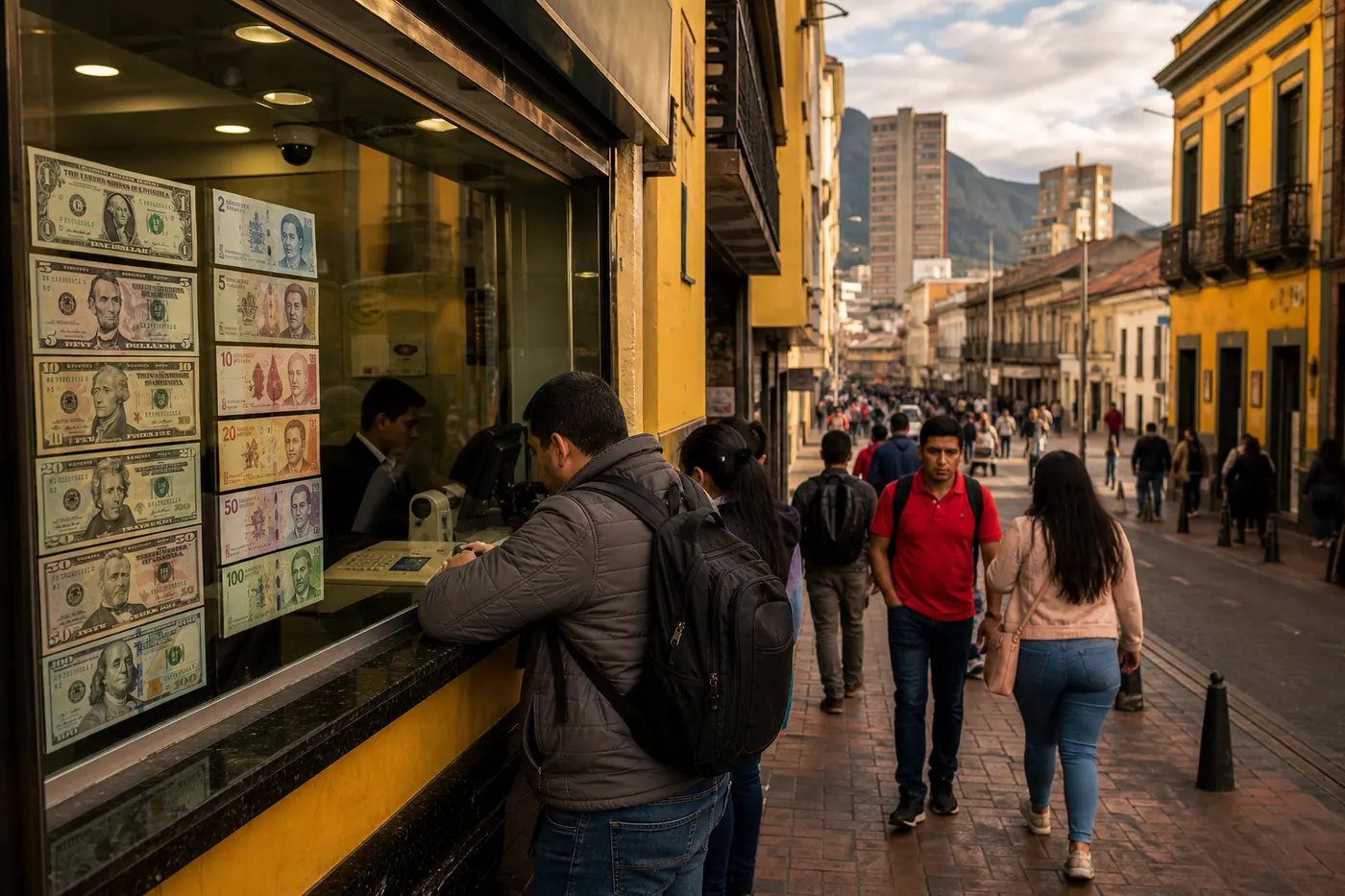
Casas de cambio are licensed currency exchange businesses, and in Colombia's major cities they're the best way to convert USD or EUR bills to pesos. Quality varies significantly, so knowing where to look matters.
Where to find them
- Bogotá: The highest concentration is around Av. 19 and the surrounding streets in Centro. Also in Chapinero and inside Unicentro shopping center.
- Medellín: Near Parque Berrio in Centro, and scattered along El Poblado's main commercial strip. Some banks in Centro have exchange windows with competitive rates.
- Cartagena: Inside the walled city (Centro Histórico), near the Banco de la República area and Portal de los Dulces.
- Cali: Centro near Calle 11 with Carrera 4, and some options in San Antonio.
- Santa Marta / Barranquilla: Smaller cities have fewer options — go to the commercial center or ask your hotel.
Practical tips for getting a good rate
Compare two or three casas de cambio before exchanging a large amount. Even on the same street, rates can vary by 0.5–1%, and on $500 that's a $5 difference for thirty seconds of walking. The busiest shops tend to have more competitive rates.
Bring your bills in good condition. Colombian exchangers inspect USD carefully for fakes and will refuse old, torn, or heavily written-on notes. The preferred series is 2006 onwards — bring post-2006 USD bills if you can. $50 and $100 denominations typically get marginally better rates than $20s or smaller. Bring your passport; any larger exchange requires ID under Colombian SARLAFT anti-money-laundering rules. It's routine paperwork, not suspicious.
For amounts over $1,000 USD, it's worth asking if there's any flexibility on the rate. A quick '¿Puede darme un mejor precio por este monto?' occasionally works. Not always — but it costs nothing to ask.
ATMs in Colombia — What Nobody Tells You
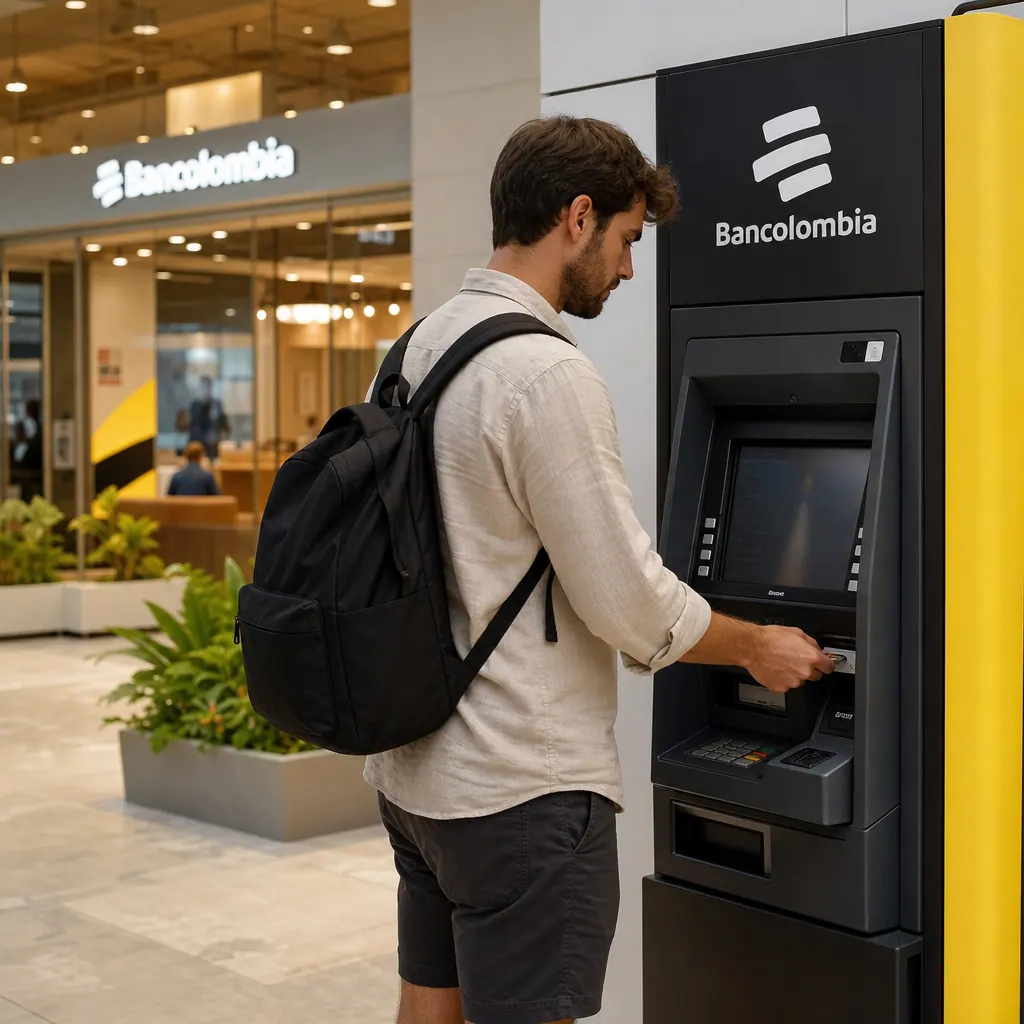
ATMs work across Colombia. Visa, Mastercard, and Cirrus cards function at any major Colombian bank's machine — Bancolombia, Davivienda, Banco de Bogotá, BBVA Colombia are all reliable. The issue is the fee stack that can make each withdrawal cost 5–8% of the amount withdrawn.
The fee breakdown
| Fee Type | Typical Amount | Charged By |
|---|---|---|
| Colombian ATM service fee | COP 7,000–14,000 (~$1.75–3.50) | Colombian bank |
| Foreign ATM fee (US banks) | $3–5 flat | Your home bank |
| Foreign transaction fee | 1–3% of withdrawal amount | Your home bank |
On a COP 600,000 withdrawal (~$150 USD), that can be $8–12 in fees — about 6–8%. On a COP 300,000 withdrawal, the same fees hit proportionally harder. The lower your withdrawal amount, the higher the effective fee percentage.
Colombian ATMs also have frustratingly low single-transaction limits: typically COP 400,000–800,000 per transaction (~$100–200 USD). Some machines allow multiple consecutive withdrawals; others impose a daily cap that resets at midnight. If you need a large cash sum, plan for multiple visits or find a casa de cambio instead.
The card that changes everything
Open a Charles Schwab High Yield Investor Checking account before coming to Colombia. Schwab reimburses 100% of all ATM fees worldwide at the end of each statement month — including the Colombian bank's service fee — and charges zero foreign transaction fees. The withdrawal rate is the Visa interbank rate, within 0.5% of the TRM. This is the most-recommended card among experienced Latin America expats, and for good reason. It takes a couple of weeks to arrive, so apply before your trip.
Credit and Debit Cards: Where They Work (and Where They Don't)
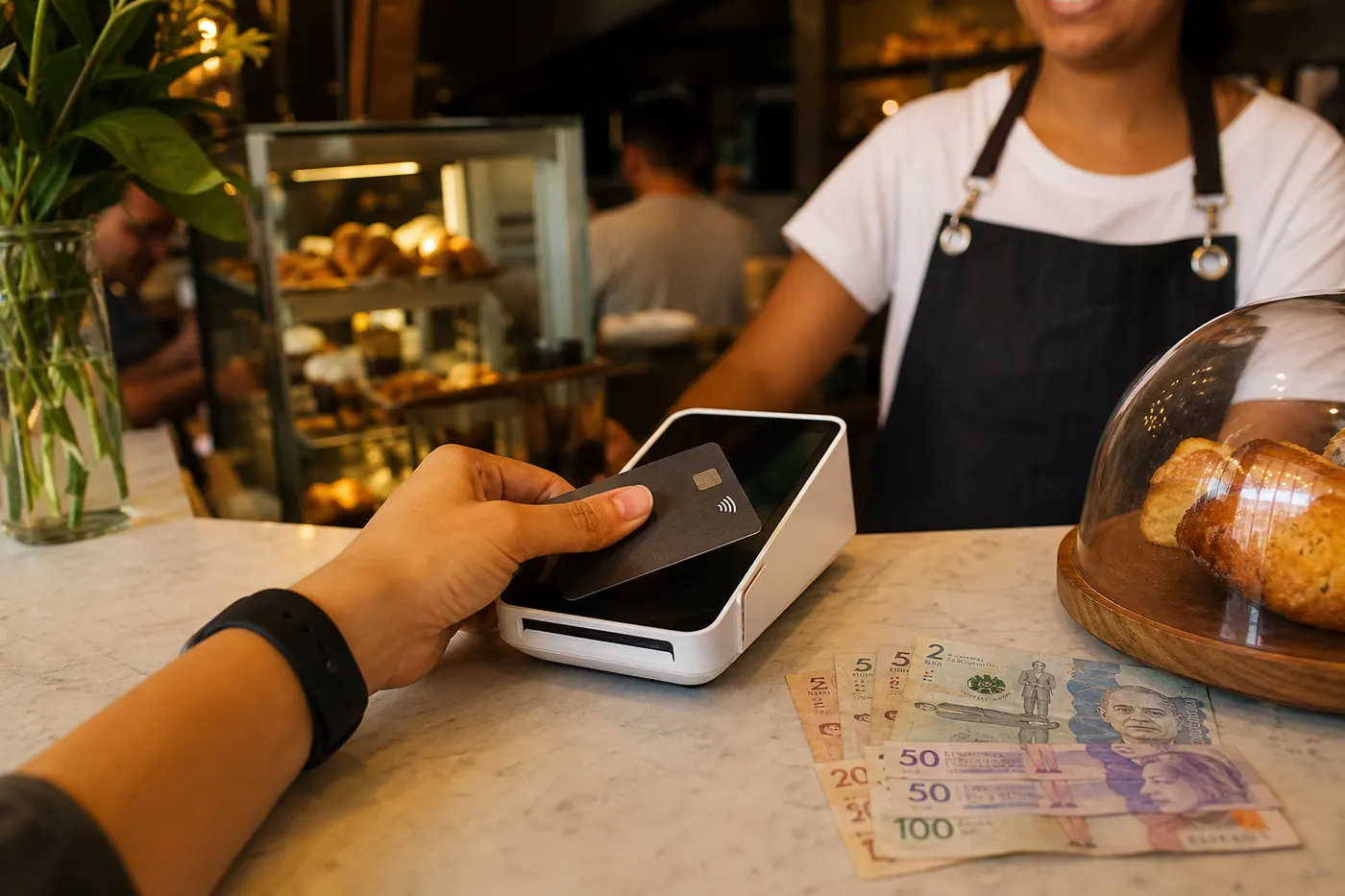
Credit cards are widely accepted in Colombia at formal businesses: chain restaurants and hotels, large grocery stores (Éxito, Carulla, Jumbo), pharmacies, shopping malls, and most retailers in commercial zones. Visa and Mastercard work almost everywhere that accepts cards; American Express has noticeably less coverage.
Cash is still necessary for: street vendors, arepas carts, tiendas de barrio (corner stores), plazas de mercado, many smaller local restaurants, intercity buses, and any informal transaction. Even in Medellín's wealthier neighborhoods, don't assume a small place takes cards. Carrying COP 50,000–100,000 in small bills as pocket change is just a practical habit.
Three rules for using cards in Colombia
- Notify your bank before traveling. Colombian transactions frequently trigger fraud alerts on foreign cards, resulting in blocks mid-transaction. Either set a travel notification in your bank app or call ahead.
- Always pay in COP, never in your home currency. Point-of-sale terminals may offer "dynamic currency conversion" — paying in USD or EUR. Decline every time. The conversion rate is usually 8–12% above market. Always select COP at the terminal.
- Check your card's foreign transaction fee. Most US bank debit and credit cards charge 1–3% on foreign transactions. Cards that waive this (Chase Sapphire Preferred, Capital One Venture, Schwab debit) are worth bringing specifically for Colombia.
The Airport Exchange — When It's Acceptable and When It Isn't
I want to be precise here, because blanket 'never use the airport exchange' advice isn't quite right. There are situations where it's fine: you're arriving at 4 AM, your hotel is an hour away, the ATM is broken, and you need COP 80,000 for a taxi. Paying an 8% premium on $20 is $1.60. That's fine.
The mistake is using the airport exchange for your main cash supply. Changing $300 at El Dorado airport to 'get it done' costs you roughly $20–25 compared to a city-center casa de cambio. That's an excellent meal in Colombia, or half a day of rideshares.
The airport ATMs are also worse than city ATMs, though not as bad as the exchange window — the flat service fees are the same, but the rate is at least market-based. If you need immediate taxi money on arrival, the ATM is better than the exchange booth: withdraw COP 150,000–200,000 (~$40 USD) to cover transport, then find a proper exchange once you're settled. Better still, arrive with some small USD bills and negotiate the taxi fare in dollars if needed — informal airport taxi drivers often accept USD.
Digital Alternatives That Often Beat Physical Exchange
Wise (formerly TransferWise) is the right tool when you need to convert larger amounts from a foreign bank account — not from physical cash, but from USD/EUR held digitally. It gives you the mid-market rate with a transparent 0.5–1.5% fee, paid directly into any Colombian bank account. We cover the full setup and mechanics in our guide to receiving foreign income in Colombia.
For personal transfers — someone in the US or Europe sending you money — Remitly is competitive and fast. It delivers to Colombian bank accounts or directly to Nequi within hours. Rates are usually better than a bank wire and comparable to a mid-tier casa de cambio rate for the amount. Not designed for business income, but excellent for personal needs.
If you have a Colombian bank account or Nequi set up, you can operate almost entirely without cash for daily spending in major cities — Nequi QR code payments are accepted almost everywhere cards are. See our guide to Nequi and DaviPlata for foreigners for the setup process, which is possible with a foreign passport in some cases.
📖 Keep Reading
Getting paid from abroad involves more steps than exchanging cash — SWIFT wires, Wise receiving accounts, and Colombia's declaración de cambio. See the full breakdown: How to Receive Foreign Income in Colombia
Carrying Cash Safely in Colombia
Once you have pesos in hand, a few habits keep them there.
Don't count or display cash in public — wait until you're in your accommodation, a restaurant, or somewhere private. Walking out of a casa de cambio and immediately sorting bills on the pavement is an invitation for trouble. Same goes for standing at an ATM counting your withdrawal while people pass behind you.
Split cash across multiple locations: a working amount in a front pocket, more in a wallet, reserves in an inner bag pocket or money belt. This way, a grab-and-run doesn't cost you everything. Most theft in Colombia is opportunistic — someone sees an easy target and acts. Making yourself a slightly harder target usually means you get left alone.
For large cash transactions — paying a month's rent deposit, purchasing a vehicle — ask about bank transfer alternatives before carrying the amount physically. Most landlords and private sellers accept Bancolombia transfers. See our Colombia safety guide for foreigners for a full breakdown of street awareness habits that experienced expats use.
Frequently Asked Questions
❓ What's the best way to exchange money in Colombia?
A licensed casa de cambio in a major city center gives you the best rate for physical cash — typically within 1–2% of the official TRM. For digital amounts arriving from abroad, Wise beats nearly every alternative. Avoid airport exchange windows for anything more than small taxi money.
❓ Can I use my US credit or debit card in Colombia?
Yes — Visa and Mastercard work at most formal businesses and Colombian ATMs. Notify your bank before traveling to prevent fraud blocks. Always choose to pay in COP (not USD) at payment terminals to avoid dynamic currency conversion fees. Charles Schwab's debit card is the best choice for ATM withdrawals due to worldwide fee reimbursement and no foreign transaction fee.
❓ How do I find a trustworthy casa de cambio in Bogotá or Medellín?
In Bogotá, look around Av. 19 in Centro. In Medellín, near Parque Berrio in Centro or along El Poblado's main commercial street. Search 'casa de cambio' in Google Maps and read recent reviews. Busy shops with regular customers tend to offer more competitive rates. Check today's TRM first so you can evaluate any quoted rate in seconds.
❓ What USD bills do Colombian casas de cambio accept?
Most accept post-2006 USD bills in good condition. Old series bills (pre-2006), torn notes, or heavily written-on bills may be refused or discounted. $50 and $100 denominations typically get slightly better rates than $20s or smaller. EUR is widely accepted; other currencies (GBP, CAD) depend on the specific casa de cambio.
❓ Is it safe to carry cash in Colombia?
In major expat and tourist neighborhoods — El Poblado, Laureles, Chapinero, the walled city of Cartagena — carrying normal daily-spending amounts of cash is routine and safe with basic awareness: keep it in a front pocket, don't count it in public, don't flash it unnecessarily. Avoid carrying large sums unnecessarily; for big transactions, bank transfers are often a better option.
💬 Have a money question?
Exchange rate confusions, ATM issues, bank account questions — the expat community at colombiamove.com/comunidad has seen most of it. Ask there and get answers from people who live it.
Comments
Loading comments...
Checking sign-in status...